
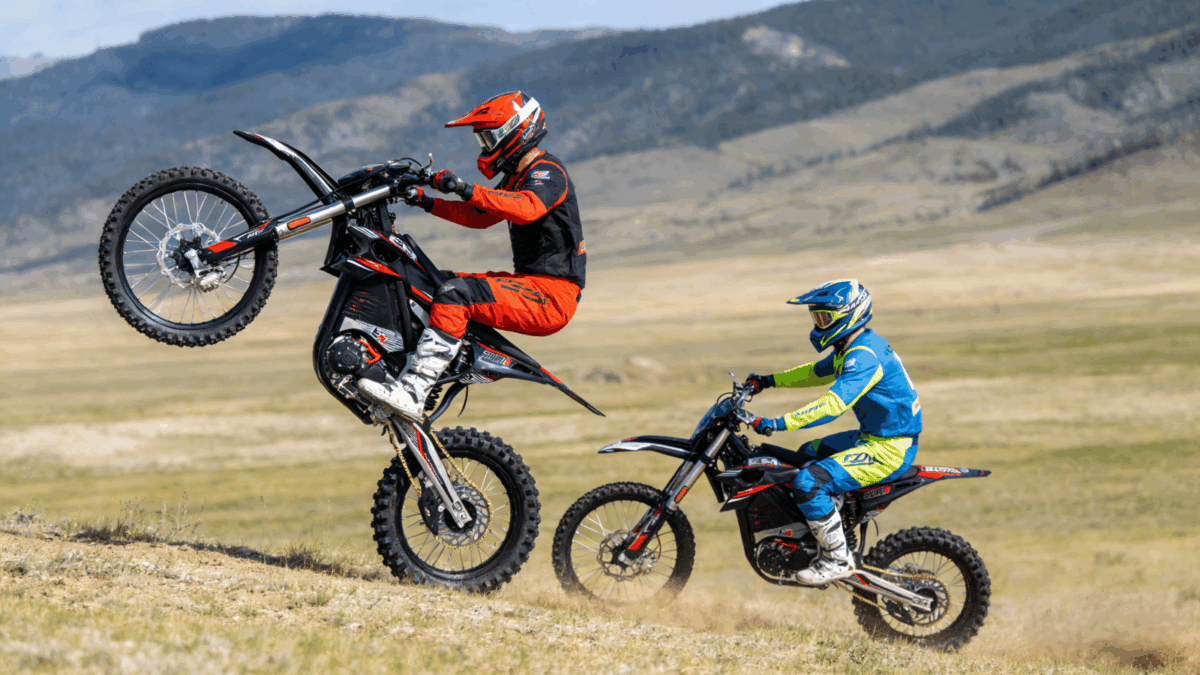
The rumble of a two-stroke engine and the smell of premix have been synonymous with dirt biking for decades. For many purists, the idea of an Off Road Electric Motorbike seems like an oxymoron—a quiet, battery-powered machine couldn’t possibly handle the gnarliest trails or survive a motocross race.
However, the reality on the trails and tracks tells a different story. With advancements in battery technology, motor design, and chassis engineering, electric dirt bikes are not just catching up; in some areas, they are outperforming their gas-guzzling rivals. From the Stark Varg dominating motocross discussions to the Ultraviolette F77 tackling rugged terrain, the revolution is underway .
Despite this progress, several misconceptions persist. It’s time to put these myths to rest. Here is the truth behind seven common myths about the off-road electric motorbike.
Myth 1: They Don’t Have Enough Power or Torque
The Reality: Instant Torque Changes Everything
This is arguably the biggest misconception. If you simply compare spec sheets, you might see a high-performance electric bike boasting figures that seem modest compared to a 450cc motocross bike. However, horsepower and torque figures are not created equal across the two powertrains .
In a gasoline engine, power builds as the RPMs climb. To get maximum thrust, you need to downshift, slip the clutch, and keep the engine in the “power band.” An Off Road Electric Motorbike is fundamentally different. Electric motors deliver 100% of their torque available from 0 RPM . There is no lag, no clutch work, and no waiting for the revs to build.
Take the Zero DSR/X, for example. It cranks out a staggering 166 lb-ft of torque—more than a gas-powered liter-class adventure bike . When you twist the throttle on an electric bike, the power is instantaneous and violent. Furthermore, because of the way power is certified (continuous vs. peak power), an electric bike with a modest “continuous” rating can have a massive “peak” rating for short bursts, giving it explosive acceleration out of corners and up hill climbs .
Myth 2: Range Anxiety Makes Them Useless for Long Rides
The Reality: 100+ Mile Ranges Are Here, and Charging Is Easier Than You Think
Range anxiety is the go-to argument for skeptics, but the numbers—and real-world tests—prove otherwise. Modern off-road electric motorcycles are equipped with massive battery packs. The Ultraviolette F77 features a 10.3 kWh battery capable of covering up to 323 km (200 miles) on a single charge in ideal conditions . The Zero DSR/X, designed for adventure touring, offers a 17.3 kWh battery that delivers a real-world range of roughly 110 miles even with mixed aggressive riding, and up to 150 miles in slower, technical off-road terrain .
Moreover, charging is far more accessible than most realize. You don’t always need a specialized Supercharger. Adventurer Roman Nedielka rode his electric motorcycle across the deserts of Kazakhstan and through Southeast Asia, proving that as long as you have access to a standard wall plug, you can ride .
“If you can ride an electric bike around the world, don’t worry [about] riding it in your city or going for a weekend ride with your friends,” Nedielka notes .
For hardcore trail riding, the regenerative braking system also helps. When descending hills or decelerating, the motor acts as a generator, putting juice back into the battery and extending your time on the trail .
Myth 3: They Are Too Expensive to Maintain
The Reality: Drastically Lower Maintenance Costs
If you have ever raced dirt bikes, you know the maintenance grind: frequent oil changes, air filter cleaning, top-end rebuilds, clutch replacements, and constant jetting adjustments for altitude changes. Electric motorcycles obliterate this checklist.
Because electric motors have far fewer moving parts, maintenance costs are significantly lower. There are no oil changes, no spark plugs, no air filters, and no clutch cables to replace . The drive system often uses a belt or shaft, eliminating chain maintenance .
According to industry data, annual maintenance costs for an electric motorcycle average $300-$500, compared to $600-$1,000 for combustion engines . While tires may wear slightly faster due to the instant torque (approximately 12-18% faster on the rear), you save a fortune on engine and transmission work .
Myth 4: They Are Just “Quiet” and Therefore Dangerous
The Reality: “The Sound of Speed” and Strategic Safety
The lack of engine noise is often misconstrued as a safety hazard—the idea that hikers or other trail users won’t hear you coming. While electric bikes are quieter than screaming two-strokes, they are not silent. At speed, you still hear the whir of the motor, the slapping of the chain/belt, and the tires roosting dirt .
Many riders actually prefer the quiet. Without the engine noise, riders report less fatigue and no headaches on long journeys, eliminating the need for earplugs that touring riders often require . Environmentally, it allows riders to be less intrusive in nature preserves and quiet zones.
Furthermore, the lack of noise allows you to hear the trail better—the sound of your tires losing traction, the rocks tumbling, or other riders approaching.
Myth 5: They Can’t Handle Real Off-Road Terrain
The Reality: Engineered for the Rough Stuff
Skeptics look at the sleek lines of bikes like the LAND Moto District ADV or the Ultraviolette F77 and assume they are street bikes with knobby tires. This is a mistake. The specific engineering that goes into electric off-road bikes makes them uniquely capable .
Low Center of Gravity: The heaviest component, the battery, is mounted at the lowest point of the frame. This gives electric bikes a low center of gravity that enhances stability on off-camber trails and technical sections, making them feel much lighter and more planted than their total weight suggests .
Precise Control: With advanced traction control systems and multiple riding modes (like the “Rain Mode” on the F77 or Off-Road mode on the DSR/X), riders can tailor the power delivery to the terrain . If you are navigating loose gravel or slippery rocks, you can dial back the aggression to prevent spinning out, something that requires delicate clutch work on a gas bike.
Robust Hardware: New models like the LAND Moto District ADV feature long-travel suspension (7.5 inches front), 9 inches of ground clearance, and bash plates, proving they are built for serious duty .
Myth 6: Battery Production Is Worse for the Environment Than Gas
The Reality: A Lower Lifetime Carbon Footprint
While it is true that manufacturing the battery for an electric motorcycle has a high environmental impact—specifically from the mining of lithium and cobalt and the use of copper and aluminum—the overall lifecycle assessment tells a different story .
A life cycle assessment of electric motorbikes (specifically the CAKE Kalk&) shows that the use phase of a gas bike is so dirty that the electric bike quickly offsets its manufacturing debt. When charged with renewable energy, an electric bike produces zero tailpipe emissions and is significantly quieter .
Furthermore, as battery technology improves and recycling programs recover up to 90% of lithium and cobalt, the initial manufacturing impact is decreasing year over year . In countries like Uganda, switching the massive fleet of motorcycle taxis to electric is projected to reduce particulate matter in the air by 15% and save lives, highlighting the massive health benefits of zero-emission riding .
Myth 7: The Tech is “New” and Unreliable
The Reality: Proven in the World’s Harshest Conditions
The “new tech” myth is fading as electric motorcycles complete feats that would destroy lesser machines. Sinje Gottwald became the first person to cross the entire continent of Africa unassisted on an electric motorcycle. Tucker Neary completed the Colorado Backcountry Discovery Route (over 1,000 miles of extreme terrain) on a Zero DSR .
These journeys involve dust, water crossings, extreme heat, and massive elevation changes—exactly the conditions skeptics claim electric bikes can’t handle. Additionally, the “complexity” of the tech is often overstated. While gas bikes require intricate carburetor tuning and valve adjustments, electric bikes rely on rugged, sealed battery management systems and firmware updates that can be done over-the-air (OTA) .
Summary: The Verdict on Electric Dirt Bikes
| Myth | Reality |
|---|---|
| Not enough power | Instant torque from 0 RPM provides explosive acceleration that rivals or beats gas bikes . |
| Terrible range | Real-world ranges of 100+ miles are common, with charging available from standard wall outlets . |
| High maintenance | Fewer moving parts mean no oil changes, no air filters, and annual costs 40-50% lower than gas . |
| Too quiet/dangerous | Quieter operation reduces rider fatigue and allows for better trail awareness; not silent at speed . |
| Can’t handle terrain | Low center of gravity, advanced traction control, and long-travel suspension make them extremely capable . |
| Dirty to produce | Lifecycle analysis shows lower overall emissions, especially when charged with renewables . |
| Unreliable tech | Proven in round-the-world adventures and extreme off-road races; relies on rugged, sealed components . |
The Off Road Electric Motorbike segment is no longer a futuristic concept; it is the present. As battery density increases and charging infrastructure expands, the question is shifting from “Can electric bikes compete?” to “Why would you buy a gas bike?” Whether you are tackling a rocky single-track, crossing a desert, or simply enjoying a silent sunset ride, today’s electric dirt bikes are ready to prove you wrong.
