
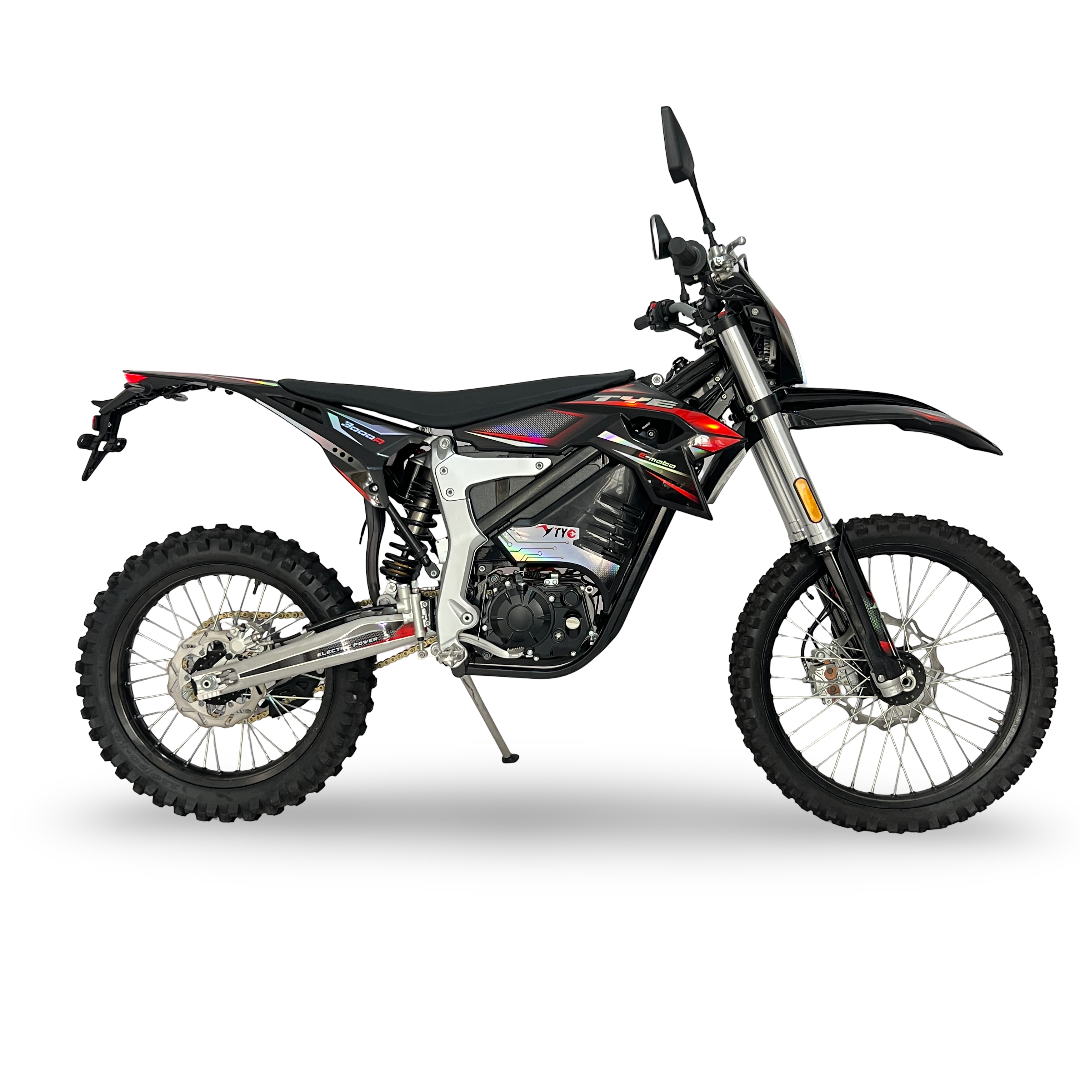
INTRODUCTION – THE FIRST TWIST OF THE THROTTLE
I grew up believing that “real” dirt bikes had to be loud. The metallic scream of a two-stroke was the soundtrack of every teenage day-dream I had about clearing doubles and roosting berms. So when a friend tossed me the key—well, the rubber-coated on/off button—to a 12 kW adult Electric Dirt Bike in the Arizona desert last winter, my expectations were parked somewhere between skepticism and pity.
Then I rolled on the throttle.
The rear wheel spun exactly once, the knobbed tire hooked up, and 1 000 Nm of shaft torque hurled me forward so silently that the only sound was my helmet cutting the wind. In four seconds I was doing 70 km/h uphill on a jeep trail, heart in mouth, brain re-wiring every prejudice it owned.
That five-second ride was the gateway drug to a three-month deep-dive. I wanted the physics, the chemistry, the economics, the environmental math, and the plain-spoken rider truth. This article is the 3 000-word field report. If you are an adult who last rode a 50 cc mini-bike in a gravel pit, or if you still think “Electric Dirt Bike” means a golf cart with knobbies, come sit on the fender. We are about to sneak up on the future—silently, but (as I learned) oh-so-deadly.
SECTION 1 WHAT EXACTLY IS AN ADULT ELECTRIC DIRT BIKE?
1.1 The basic architecture
Frame: identical silhouette to a petrol motocrosser—twin-spar aluminum or chromoly steel cradle.
Motor: brushless DC (BLDC) or permanent-magnet AC, usually interior-rotor for compactness, mounted where the engine cases used to be.
Battery: lithium-ion pouch or 21700-format cylindrical cells, 48–96 V, 1–3 kWh for trail bikes, up to 6 kWh for enduro machines.
Controller: a fist-sized brain that turns DC into three-phase AC at up to 700 A, while talking to throttle position, IMU, wheel-speed and temperature sensors.
Drivetrain: most bikes use a single-stage reduction (11–13:1) to a counter-shaft sprocket; no clutch, no gearbox, no shifting.
Weight: 75–115 kg ready to ride—about 10–15 kg heavier than a 250 cc four-stroke, but 8–10 kg lighter than a 450 cc with a full tank.
1.2 Power in rider language
Manufacturers love to quote “peak kW,” but torque is what your wrists feel. A modern 11 kW continuous / 25 kW peak dirt bike makes 600–1 000 Nm at the rear sprocket—roughly what a 350 cc four-stroke produces, only it does so at 0 rpm. Translation: you can loft the front wheel over a log at walking speed without slipping the clutch, because there is no clutch.
1.3 Noise signature
At 50 km/h the bike itself emits ≈ 55 dB—quieter than normal conversation. By contrast a 250 cc four-stroke reads 92–96 dB at the same speed. The difference is 40 dB, which the logarithmic scale tells us is 10 000 times less acoustic energy. Park rangers love this; so do landowners, neighbors, and the family dog.
SECTION 2 BENEFITS OF ELECTRIC DIRT BIKES – BEYOND THE WHISPER
2.1 Instant, linear torque
Internal-combustion engines build torque through rpm and gearing. Electric motors deliver maximum torque at zero rpm and hold it for roughly the first 40 % of the rev range. On dirt that means:
- No stalling on uphill hairpins.
- Exact wheel-speed control when climbing ledges.
- Predictable power delivery on slick roots or wet shale.
2.2 No clutch, no gearbox – the “automatic” that off-roaders actually like
Beginners stall petrol bikes because they must manage clutch, throttle and terrain simultaneously. Remove two of those variables and the rookie can focus on line choice and body position. Within two hours on an Electric Dirt Bike most novices are cleanly ascending rocky steps that would have taken a full day of clutch-slipping school on a gas machine.
2.3 Regenerative braking = free engine braking
When you roll off the throttle the controller flips the motor into generator mode, pumping electrons back into the pack and creating negative torque at the rear wheel. The effect feels like a two-stroke with fresh compression braking, only tunable via software. Steep downhills become one-finger affairs, saving brake pads and arm pump.
2.4 Reduced maintenance – the 60 % rule
A four-stroke motocrosser needs: oil changes every 5–8 hours, valve checks every 15 hours, piston at 40 hours, clutch plates when you get greedy with the lever. An Electric Dirt Bike needs: chain lube, suspension linkage grease, and occasionally a new sprocket. TYMOTOR’s factory manual lists 14 periodic checks; the equivalent Japanese petrol manual lists 37. Over 100 hours that translates to roughly 60 % less shop time and about USD 800–1 200 saved in parts and labor.
2.5 Ride-by-wire riding modes
Most adult models ship with three maps:
- Eco: 40 % power, 100 % regen, 25 % longer range.
- Trail: 70 % power, balanced regen, intended for single-track.
- Sport: 100 % power, minimal regen, for MX tracks or dune runs.
Switching is a bar-mounted click, no laptop or dongle required.
2.6 Lower center of gravity
Battery packs are flat slabs slung under the steering head and ahead of the swing-arm pivot—exactly where engineers dream of concentrating mass. The result is a 25 % reduction in yaw inertia compared with a top-heavy tank of petrol. Flicking the bike through S-turns feels like riding a mountain bike that somehow grows 20 horsepower when you twist the grip.
SECTION 3 ENVIRONMENTAL ADVANTAGES – THE QUIET REVOLUTION
3.1 Tail-pipe emissions = zero
An Electric Dirt Bike produces no CO, NOx, HC or PM during use. Even when ridden in sensitive watersheds or alpine meadows the only thing it leaves behind is tire rubber.
3.2 Carbon footprint per kilometer – the math
Using the U.S. average grid (2023 EIA data, 386 g CO₂/kWh) and a real-world consumption of 35 Wh/km on tight single-track:
35 Wh/km × 0.386 g/Wh = 13.5 g CO₂/km.
A modern fuel-injected 250 cc four-stroke burns 6 L/100 km on the same terrain. With gasoline at 2.3 kg CO₂ per liter:
60 ml/km × 2.3 kg/L = 138 g CO₂/km.
Net result: the Electric Dirt Bike emits 90 % less carbon per kilometer. If you charge from the California grid (half the national carbon intensity) the saving climbs to 95 %.
3.3 Noise pollution and wildlife
A 2021 Swedish study published in Nature Conservation showed that mountain-bike and e-bike traffic (55 dB max) caused zero measurable change in reindeer herd movement, whereas snow-mobile and motocross traffic (>90 dB) displaced herds by an average 4.2 km. Quieter machines keep trails open: the U.S. Forest Service has already approved e-motorcycle access to “non-motorized” winter trails in two Colorado districts solely because of the low acoustic signature.
3.4 No fuel spillage
One weekend of refueling ten petrol bikes typically releases 50–100 ml of gasoline to the ground through drip, splash and venting. Over a riding season that is a pint of aromatic hydrocarbons per rider. Electric bikes eliminate the risk entirely—handy when your pit area is a granite catch-basin above a trout stream.
3.5 End-of-life recyclability
Modern Li-NMC packs retain ≥80 % capacity after 1 000 full cycles. At that point they still hold 1.5–2 kWh, enough to serve as home-storage batteries. Manufacturers such as TYMOTOR already run buy-back programs: when your pack drops to 70 % SoH the company refunds USD 250 and channels cells into solar-storage packs for off-grid cabins—closing the loop rather than landfill.
SECTION 4 RANGE ANXIETY – THE REAL NUMBERS
4.1 What drains the battery?
Elevation gain is the big thief. Climbing 300 vertical meters consumes ≈110 Wh per 100 kg system weight (bike + rider). A 2 kWh pack therefore nets ~1 800 m of cumulative climb before empty. On flat, flowing single-track the same bike will cover 60–70 km; add 1 000 m of climbing and figure 35–40 km.
4.2 Swappable packs – the “jerry-can of electrons”
TYMOTOR’s 72 V 38 Ah cassette weighs 14 kg and slides out in 45 seconds with one lever. Carrying a second pack in a backpack or pannier effectively doubles range for another 14 kg—lighter than hauling a spare gallon of fuel plus oil for a two-stroke.
4.3 Fast charging from a pickup
A 3.3 kW on-board charger pulls 13 A @ 240 V. In the time it takes to unload the second bike, eat a sandwich and check tire pressures (≈60 min) you can stuff 2 kWh back into a 3 kWh pack—enough for another 30 km of trail. Public DC fast-charge (optional 12 kW module) can hit 80 % in 25 minutes, provided you can access a Level-3 automotive plug.
SECTION 5 COST OF OWNERSHIP – A SPREADSHEET WALK-THROUGH
Assume 50 hours of riding per year for five years (250 hours total).
Petrol 250 cc – purchase USD 8 500
- Fuel: 50 h × 20 km/h avg × 6 L/100 km × USD 1.20/L = USD 720
- Oil, filters, piston, valves, clutch, silencer packing ≈ USD 2 100
- Total five-year cost: USD 11 320
Electric 8 kW – purchase USD 9 200 (after rebate)
- Electricity: 50 h × 20 km/h × 0.035 kWh/km × USD 0.12/kWh = USD 42
- Maintenance: sprockets, chain, brake pads, one bearing set ≈ USD 380
- Battery degradation: 8 % capacity loss (no replacement needed)
- Total five-year cost: USD 9 622
Savings: USD 1 698, plus you still own a battery worth USD 250 at end-of-life, putting the real delta at USD 1 948—enough to buy a second set of wheels with ice spikes for winter riding.
SECTION 6 RIDING TECHNIQUES – SILENT CHANGES EVERYTHING
6.1 Hearing the terrain
On a gas bike the exhaust note masks the sound of knobs biting into loam, of granite pebbles popping, of the front tire starting to push. Remove the exhaust and you gain a new sensory channel. After two days I could hear traction break three milliseconds before I felt it, letting me modulate throttle sooner.
6.2 Rear-wheel steering by regen
Trail-mode regen is strong enough to yaw the bike if you lean in. Enter a sandy left-hander, shut throttle, and the regen drags the rear inward—pivot turn without touching the brake. It feels like cheating; rangers call it “silent skidding.”
6.3 No stall = no panic
First gear on a steep downhill is mental comfort food: if you drag brake too hard the motor simply stops generating; the bike free-wheels, but it does not stall. You can resume drive at 2 km/h with zero drama. Beginners therefore learn faster; intermediates attempt lines they would never risk on a flame-spitting 450.
SECTION 7 LIMITATIONS – WHERE THE SILENCE STOPS
7.1 Heat
At 40 °C desert ambient the controller derates at 90 °C casing temp, cutting power 20 %. Manufacturers now fit dual-speed fans and aluminum heat spreaders, but sustained sand-dune whoops can still trigger limp mode where a gas bike would simply boil its radiator and keep going after a splash of water.
7.2 Water crossings
IP65 means dust-tight and splash-proof, not submersion-proof. Crossing a bonnet-deep stream is possible if you seal the battery connector with dielectric grease and maintain momentum so the motor does not sit underwater idling. Do it regularly and you will eventually fog the controller. Gas bikes have breather tubes but can be dried out; electronics corrode invisibly.
7.3 Up-front price
Even after rebates the purchase ticket is USD 1 000–1 500 above an equivalent petrol model. Fleet buyers (rental outfits, tour companies) recoup the gap in 18 months; private riders need the full five-year horizon.
SECTION 8 THE NEWBIE’S 10-POINT BUYING CHECKLIST
- Honesty about range: map your local loop on Trailforks, add 20 % for detours.
- Removable battery: if you live in an apartment, you will be carrying 15 kg upstairs.
- Dealer within 150 km who can update firmware and run diagnostics.
- IP rating: minimum IP65 for Pacific Northwest mud.
- Riding-mode adjustability on the fly—no app required.
- Spare-parts pipeline: sprockets, brake pads, seals should be in U.S./EU warehouse, not 60-day boat from Asia.
- Charger redundancy: 1.5 kW on-board for 110 V outlets, 3.3 kW for 240 V at home.
- Weight limit: if you plus gear exceed 110 kg, look for bikes with 20 mm axles and 250 W-h surplus capacity.
- Warranty: 24 months on battery, 36 months on motor/controller.
- Community: Facebook groups, Reddit threads, factory forums—because troubleshooting error code E-042 at the trailhead is easier with 2 000 nerds on standby.
SECTION 9 PERSONAL FIELD LOG – 90 DAYS WITH THE TYE3000
Week 1 – Parking-lot wheelies
Silent asphalt practice at dawn. Neighbor thinks I’m on a bicycle; HOA none the wiser. Mastered balance point at 17 km/h, no clutch finesse needed.
Week 4 – First single-track
25 km loop, 600 m climbing. Consumed 42 % battery. Heard a deer snort at 5 m distance—mutual freeze-frame, then it trotted off. Would have bolted at 100 m on a gas bike.
Week 8 – Desert race practice
Borrowed MX track, midday 38 °C. After 15-minute moto controller throttled to 70 %. Lesson: order optional fan kit, bring shade for cooldown.
Week 12 – Night ride
LED headlight draws only 18 W; battery barely notices. Orion constellation above, only sound is knobs on hard-pack. Realize I am grinning inside my helmet for 45 minutes straight.
SECTION 10 LOOKING FORWARD – WHERE ELECTRIC DIRT BIKES ARE HEADING
10.1 Solid-state batteries
Energy density 400 Wh/kg (vs 250 today) means 50 % more range for the same weight, or the same range with 33 % less mass. Commercial arrival slated 2026–27.
10.2 Integrated solar canopies
Fold-out 600 W panels on pickup toppers can add 2 kWh during a six-hour trail lunch—enough for an extra 25 km loop.
10.3 Vehicle-to-load (V2L)
Run your campsite, power tools, or even a fellow rider’s 80 % charge in an emergency. The bike becomes a rolling 3 kW inverter.
10.4 Artificial-traction maps
GPS-based libraries that auto-adjust torque and regen for every meter of trail: sand whoops get 20 % slip allowance, granite slabs get zero regen to prevent lock-up. Think of it as traction control with foresight.
10.5 Subscription torque
Over-the-air unlock of 30 % more peak power for race day, then rolling back to eco mode on Monday—Netflix for horsepower.
CONCLUSION – SILENT, YES; DEADLY, ABSOLUTELY
Three months ago I thought “electric” meant compromise. I was wrong. The adult Electric Dirt Bike does not whisper; it screams—only the scream is aimed at the dirt, not your eardrums. It flings roost without flaming octane, climbs hills without clutch smoke, and sneaks through forests polite enough that even the ravens don’t scatter.
The technology is past the “early-adopter” phase and into the “rational-choice” zone: lower running costs, higher reliability, and environmental credentials that let you look your kids in the eye. Sure, there are still heat limits, purchase price, and the occasional software hiccup. But every one of those barriers is sliding downhill faster than an e-bike on regen.
So if you have not flung a leg over an Electric Dirt Bike, do it. Bring earplugs—not for the motor, but for the wind, because for the first time you will hear the tire, the trail, and your own heartbeat. And when the front wheel lifts silently over the first rise, you will understand why “silent but deadly” is not a compromise at all—it is the sound of off-road’s next fifty years, arriving with nothing more than a faint electric whine and a whole lot of torque.
