
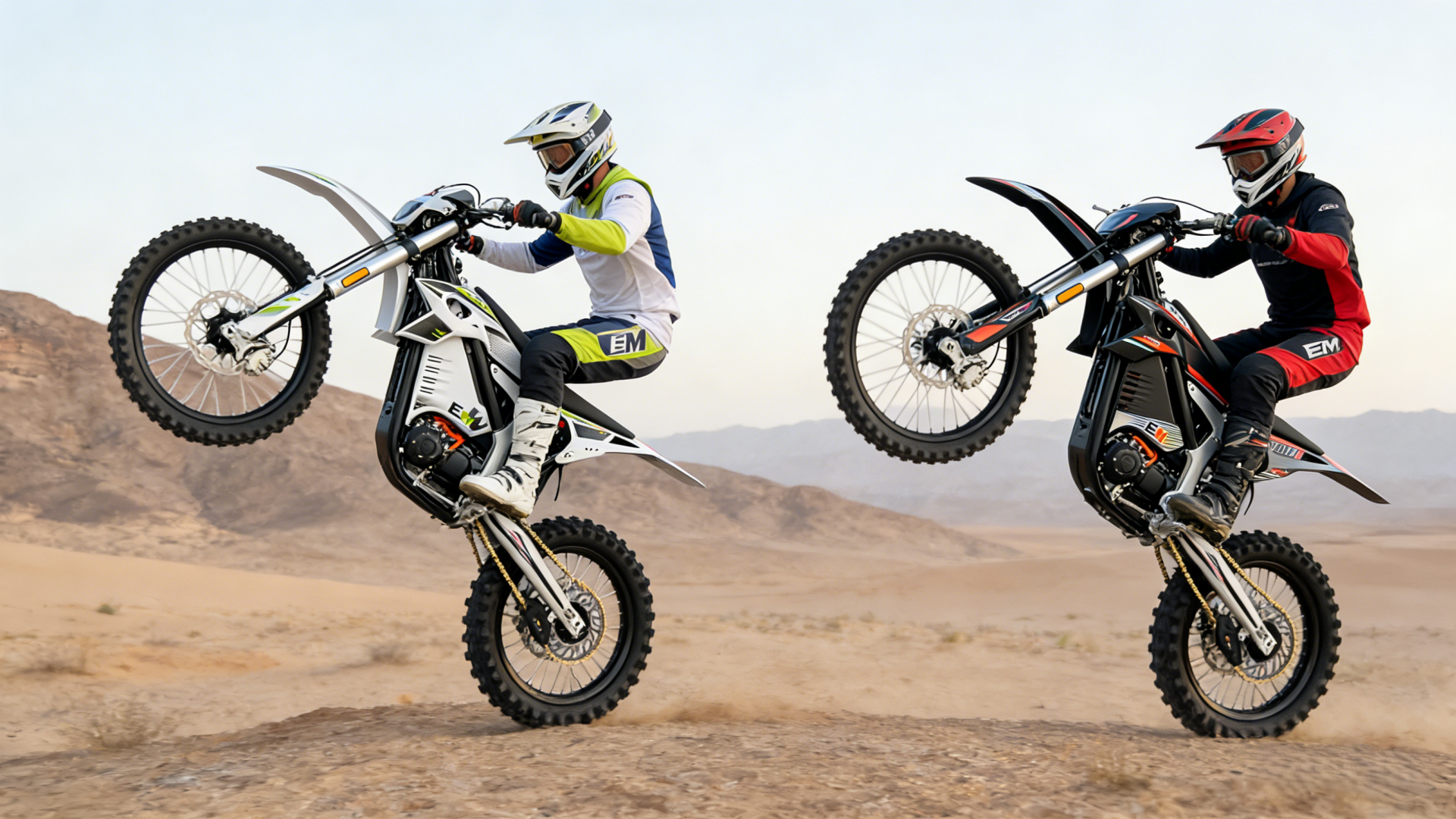
How the Oil Shock of the U.S.-Iran Conflict is Electrifying the Off-Grid Frontier
Introduction: The End of the Petroleum Paradigm
In the arid landscape of modern geopolitics, few things are as volatile as the flow of crude oil. As of 2026, the escalating conflict between the United States and Iran has transformed the Strait of Hormuz—a narrow passageway through which a fifth of the world’s petroleum transits—into a digital minefield of drone swarms and naval interdictions. Gasoline prices in the American heartland have spiked to levels not seen since the 1970s, and supply chains for recreational vehicles are buckling under the weight of rationing.
For the American off-road enthusiast, this is not just a geopolitical crisis; it is an existential one. The roar of the two-stroke engine, long considered the soundtrack of freedom, is becoming an unaffordable luxury. Yet, every crisis carries the seed of innovation. In the silence that follows the stall of the internal combustion engine, a new king is emerging: the E-Dirt Bike.
To understand why electric dirt bikes are no longer just a niche hobby but a strategic asset in an era of energy insecurity, we must dive deep into the trinity of battery technology: Range, Power, and Longevity. Leading this charge are manufacturers like TYEMOTOR, who are redefining what is possible when you replace a gas tank with a lithium-ion array. This article will dissect the electrochemical science that allows modern e-dirt bikes to outperform their gas-guzzling ancestors, especially when the taps of petroleum run dry.
Chapter 1: The Geopolitical Catalyst – Why “Range Anxiety” Beats “Supply Anxiety”
To understand the shift, we must first acknowledge the context. The current conflict has exposed the fragility of the recreational fuel supply. In previous decades, a spike in oil prices simply meant it cost more to ride. Today, in 2026, it means unavailability. Refineries prioritize commercial diesel for logistics and agriculture over recreational gasoline. For riders in California, Arizona, and Texas, trailering a gas bike to the desert now involves a logistical calculus of hoarding stabilized fuel, often at prices exceeding $6.50 per gallon.
The E-Dirt Bike offers a radical alternative: energy independence. With a solar array on your garage roof or a simple 240V outlet in your truck bed, you are decoupled from the Strait of Hormuz. TYEMOTOR, a brand that has aggressively pursued the off-road market, markets this not merely as an environmental benefit but as a “strategic energy asset.” When gasoline becomes a weapon of geopolitical leverage, the ability to generate your own “fuel” through the grid or renewables transforms the e-dirt bike from a toy into a tool for mobility.
However, for the e-dirt bike to truly replace the gas bike, it had to solve the three core promises of battery technology. Let’s examine how modern chemistry delivers on these fronts.
Chapter 2: Range – The Chemistry of Distance
The first question any rider asks is, “How far can I go?” In gasoline terms, range is a function of tank size and efficiency. In electrics, it is a function of energy density—how much energy (measured in kilowatt-hours, kWh) you can pack into a given mass.
The Evolution of Cells
Early e-dirt bikes used outdated lead-acid or first-gen Li-ion cells that offered dismal range (under 20 miles) and suffered from severe voltage sag (power drop) as the battery drained. Modern e-dirt bikes, particularly high-performance models from TYEMOTO, utilize High-Nickel NMC (Lithium-Nickel-Manganese-Cobalt-Oxide) pouch cells or cylindrical 21700 cells.
Nickel-rich cathodes are the secret sauce. By increasing the nickel content (often above 80%), manufacturers increase the specific capacity (mAh/g) of the cell. A high-nickel NMC cell can achieve energy densities of 250–300 Wh/kg. For a rider, this translates to a 4.0 kWh battery pack that weighs roughly 40 lbs but delivers 80 to 120 miles of trail riding, or 40 to 60 miles of aggressive motocross racing.
The False Promise of “Max Range”
It is crucial to understand that range is not a static number. In the context of the current fuel crisis, many riders are trying to conserve gasoline for essential vehicles. They are turning to e-dirt bikes for recreational endurance. However, battery range is highly variable:
- Terrain: Sand dunes and deep loam increase rolling resistance, draining the battery up to 40% faster than hardpack.
- Speed: Unlike gas engines, which get optimal efficiency at mid-to-high RPMs, electric motors suffer from exponential drag losses above 45 mph.
TYEMOTO and other premium brands have mitigated this with smart battery management systems (BMS) that allow for “endurance mapping.” By limiting peak power output to 60%, the BMS can extend ride time by nearly 35%, allowing riders to explore deep backcountry without fear of being stranded—a necessity when gas stations are closed due to supply disruptions.
Chapter 3: Power – Instant Torque and the Voltage Platform
If range is the tank, power is the engine. Gas bikes have a powerband; they need to spin up to high RPMs to reach peak horsepower. Electric motors have a flat torque curve.
Voltage is Pressure
The power of an e-dirt bike is largely determined by its voltage platform. A modern e-dirt bike typically runs on a 72V to 96V nominal system. Why does voltage matter? Power (Watts) = Volts × Amps. By increasing the voltage, manufacturers can deliver massive power without needing to melt the cables with excessive current.
Consider the TYEMOTOR flagship models, which often operate on a 96V system. This high-voltage architecture allows for peak power outputs exceeding 25 kW (roughly 34 horsepower) sustained, with bursts up to 40 kW (53 hp) in “boost” mode. This is comparable to a 250cc to 450cc four-stroke gas bike.
But the real advantage is delivery. In a gas bike, if you crack the throttle at 2,000 RPM in a high gear, you stall or lug. In an e-dirt bike, torque is instantaneous. At 0 RPM, the motor produces maximum torque. For technical riding—crawling over boulders in Moab or climbing the steep, loose hills of the Sierra Nevadas—this is a superpower. You never need to slip the clutch; you modulate torque via the throttle with surgical precision.
The Thermal Ceiling
However, power comes with heat. In a war scenario or extreme off-road use, riders often push bikes to the limit. Gas engines overheat and seize. E-dirt bikes can thermally throttle—meaning if the battery or motor controller exceeds 60°C (140°F), the computer cuts power to preserve the components. Premium brands combat this with sophisticated liquid cooling loops or phase-change materials in the battery pack. TYEMOTO’s latest designs utilize a dielectric fluid immersion cooling for the battery cells, allowing for sustained high-power output even in the blistering heat of desert operations, ensuring that a rider can maintain evasive or aggressive riding without hitting a “limp mode.”
Chapter 4: Longevity – The Economics of the Battery
In an era of gasoline rationing, the economic argument for a gas bike collapses. But the economics of an e-dirt bike are dictated by cycle life. A gas engine, with proper maintenance, can run for hundreds of hours. A battery, however, is a consumable—like tires or chains—but a very expensive one.
State of Health (SoH)
Battery longevity is measured in State of Health. A battery is typically considered “end of life” for automotive or heavy off-road use when it retains 70-80% of its original capacity. For off-roaders, this is critical. If a battery degrades to 80% capacity, a bike that once did 80 miles now does 64. For extreme riding, that loss is felt immediately.
The lifespan of a battery is determined by three factors: Depth of Discharge (DoD) , Charge Rate, and Thermal Stress.
- Depth of Discharge: Lithium-ion cells prefer to live between 20% and 80% state of charge. Running a battery to 0% regularly (deep discharge) causes chemical stress, leading to the growth of dendrites (tiny lithium metal fibers) that can short-circuit the cell. Premium bikes with robust BMS, like those from TYEMOTO, enforce a “buffer” where 0% indicated is actually 5% true capacity, and 100% indicated is 95% true capacity, extending cycle life from 500 cycles to over 1,500 cycles.
- Charge Rate: Fast charging is convenient but brutal on cells. Charging at 1C (filling a battery in one hour) generates significant heat and lithium plating on the anode. In a geopolitical crisis where electricity might be sourced from a noisy generator, the temptation is to fast-charge. However, manufacturers advise that to achieve the advertised 1,000+ cycle life, riders should utilize Level 1 (standard 110V) slow charging at 0.2C to 0.3C whenever possible.
- Modularity: One of the most significant innovations brought to the market by brands like TYEMOTO is modular battery architecture. Instead of a monolithic, non-removable brick, modern e-dirt bikes often feature dual or swappable battery packs. This serves two purposes in the context of supply disruptions:
- Redundancy: If one battery pack fails, the bike can run on the second (albeit at reduced power) to get you out of the wilderness.
- Weight Management: Instead of carrying a heavy 60 lbs charger, you can carry a second 25 lbs battery, effectively doubling your range without waiting for a charge.
Chapter 5: The TYEMOTOR Paradigm – Engineering for the Apocalypse
While several manufacturers exist in the e-dirt bike space, TYEMOTO has positioned itself uniquely as the “tactical” option. In a market flooded with converted enduro bikes, TYEMOTOR builds from the ground up for structural rigidity and mission-critical reliability.
Structural Battery Packs
One of the engineering marvels borrowed from the automotive world (pioneered by Tesla and adapted by TYEMOTOR is the structural battery pack. Instead of a frame that houses a battery box, the battery cells are integrated into the chassis of the bike. This lowers the center of gravity drastically—making the bike feel lighter than it is—and increases the torsional rigidity of the frame by nearly 20%.
In the context of war or energy shortages, this matters because it allows for field repairability. A gas bike relies on a complex engine with hundreds of moving parts requiring precise timing. An e-dirt bike has three main electrical components: the battery, the motor, and the controller. TYEMOTO’s designs utilize a “skid plate bus” system where the entire powertrain can be swapped in the field with basic hand tools. If a motor burns out, you don’t need a master mechanic; you need four hex bolts and a plug.
Regenerative Braking as a Force Multiplier
Another feature that becomes critical when energy is scarce is regenerative braking. On a gas bike, every time you brake, you convert momentum into heat (waste). On a TYEMOTO e-dirt bike, the motor reverses role to become a generator, putting energy back into the battery. On steep descents, this is transformative. A 5,000-foot mountain descent can actually add 5-10% range to the bike. For riders operating in remote areas where fuel resupply is impossible, this feature turns topography into a fuel source.
Chapter 6: The Future – Solid State and Synthetic Fuels
As the U.S.-Iran conflict continues to destabilize global oil markets, the investment in battery technology is accelerating at a pace unseen since the smartphone revolution.
The next frontier for e-dirt bikes is Solid-State Batteries. Current lithium-ion batteries use a liquid electrolyte that is flammable and temperature-sensitive. Solid-state batteries replace this with a ceramic or solid polymer electrolyte. The benefits are threefold:
- Safety: They are non-flammable. In a crash, there is no risk of thermal runaway (fire).
- Energy Density: Solid-state promises densities exceeding 400 Wh/kg, which would put e-dirt bike range on par with gas bikes (150+ miles of aggressive riding).
- Fast Charging: Solid-state cells can accept ultra-fast charging (5 minutes to 80%) without the degradation issues of liquid electrolytes.
TYEMOTO has reportedly invested heavily in solid-state prototyping, aiming to release a “Gen 3” platform by late 2027. If successful, this will completely sever the tie between off-road recreation and the petroleum supply chain.
Conclusion: The Silent Freedom
The roar of the internal combustion engine has been the anthem of American off-road culture for a century. But that roar comes with a leash—a leash tied to the whims of oil-rich nations, the security of tanker routes, and the stability of global supply chains. The current conflict with Iran has snapped that leash.
In its place, the E-Dirt Bike offers something more profound: silent freedom. With advanced battery technology that delivers usable range, instantaneous power, and durable longevity, modern electric motorcycles are not just alternatives; they are superior tools for the era of energy uncertainty.
Brands like TYEMOTO are leading the charge by treating the battery not as a fuel tank, but as the central nervous system of the machine. They understand that for the rider, a dead battery is more than an inconvenience—it is a vulnerability. Through high-nickel chemistries, structural integration, and smart thermal management, they have created machines that thrive in the extremes.
When the gas stations are closed and the pumps are dry, the future of the off-road world will not be found in a barrel of oil. It will be found in a lithium-ion cell, charged by the sun, and ridden in the echoing silence of a world learning to move beyond petroleum.
The internal combustion engine had its century. The age of the battery—and the freedom it secures—has just begun.
